Best Backpacking Backpacks 2026 | Tested and Reviewed by Our Gear Experts
Hiking backpacks for trekking and backpacking come in a range of capacities and designs and choosing the right one can be tricky. We're here to help you with that.
In this article, we’ve compiled the results of our staff’s in-depth testing for the latest and greatest multi-day hiking backpacks. Dozens of backpacking packs have been tested and we’ve narrowed them all down into a list of our top performers.
What to look for when choosing a pack? Backpacking packs for hiking come in a variety of sizes. The size that’s best for you depends on the trips you intend on undertaking. If you’re trekking between huts or hostels, especially in warmer weather, a 35-litre backpack should be adequate. Ultralight backpackers – the types of people who chop off half their toothbrush – will also stick to around 35 or 40L for longer trips with a tarp or tent outer.
For those who like backpacking with a bit more comfort at night, or in colder months when you need a heftier sleeping bag and sleeping mat, something between 40 and 55 litres should be right. Backpacks over 55L should suit anyone heading into areas of wilderness for long periods of time, when there’s little chance of resupplying and you have to carry everything you need in with you.
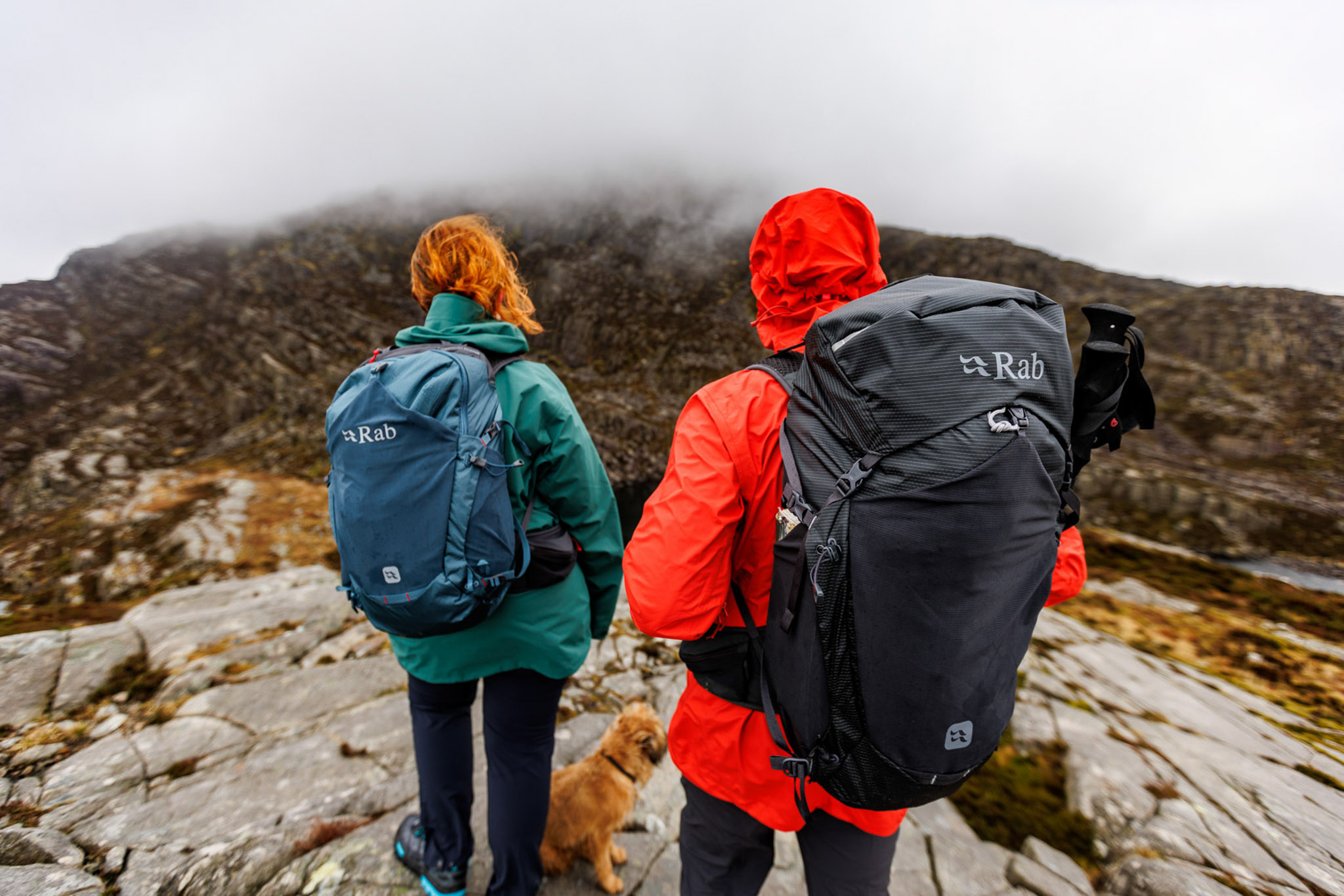
OM testers Jazz and Will hiking in the Rhinogydd using the Rab Protium range of backpacks. Photo: Dave MacFarlane.
Once you’ve decided on the size, the next consideration, and the one that you should prioritise above all else, is the carry comfort. The backpack is going to essentially be your home for a few days; it’s going to get heavy, it’s going to get annoying, and it must be comfortable. And the only way to test that is to try it on. Fortunately, here at Outdoors Magic, we’ve tested a whole bunch of backpacking backpacks so you don’t have to.
While this list covers men’s and women’s options, if you’re looking for women’s hiking backpacks specifically, we’ve done some tests for that too. Check out our results in our best hiking backpacks for women round up. Elsewhere on our site, you’ll find similar tests we’ve conducted to find the best daypacks for hiking, and the best duffel bags too.
Our Team’s Best Backpacking Backpacks for 2026
Here’s the list of the best hiking and trekking backpacks we’ve come across following our extensive testing and reviewing throughout the mountains of the UK. These are the category winners:
Editor’s Note: This article was updated in July 2026 to ensure that all of the products are still available for purchase. Osprey’s new Kestrel LT 45L also won the top spot after it impressed our gear testers.
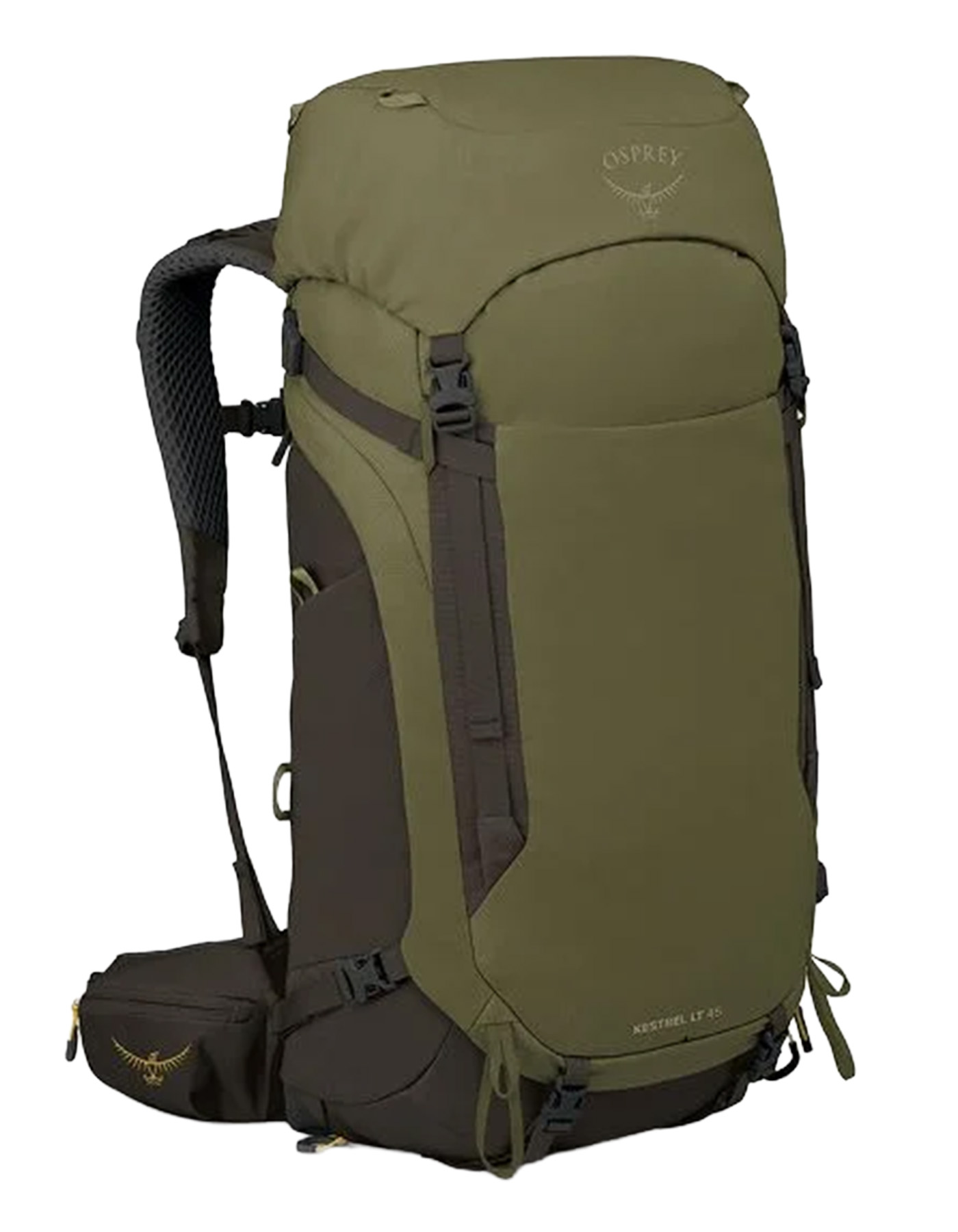
1. Osprey Kestrel LT 45L Backpack
Our winner: the best backpack overall following our tests
Where To Buy
Osprey Kestrel/ Kyte LT 45L
Our tester’s verdict: “If you want a pack that is fully-featured and durable with a high-tech back system, the Kestrel is a sensible choice. It’s a real gear-hauler that works well for overnighters.”
Price: £165 Weight: 1.83kg Best for: wild camping, hut to hut trekking, multi-day hikes Pros: durable, comfortable, loads of useful details, ergonomic, sustainably made materials Cons: only one size option, though back system is adjustable
New for 2026, we’ve been out testing Osprey’s LT (‘lightweight’) Kestrel backpack in the Lake District recently. The backpack features the same dependable performance as the original Kestrel/ Kyte series, but with a more streamlined and lightweight design.
Specifically, the materials that are used in the LT backpacks are lighter, the internal frame is more streamlined, and features such as external strapping and gear lashing points have been stripped back slightly for faster and lighter adventures.
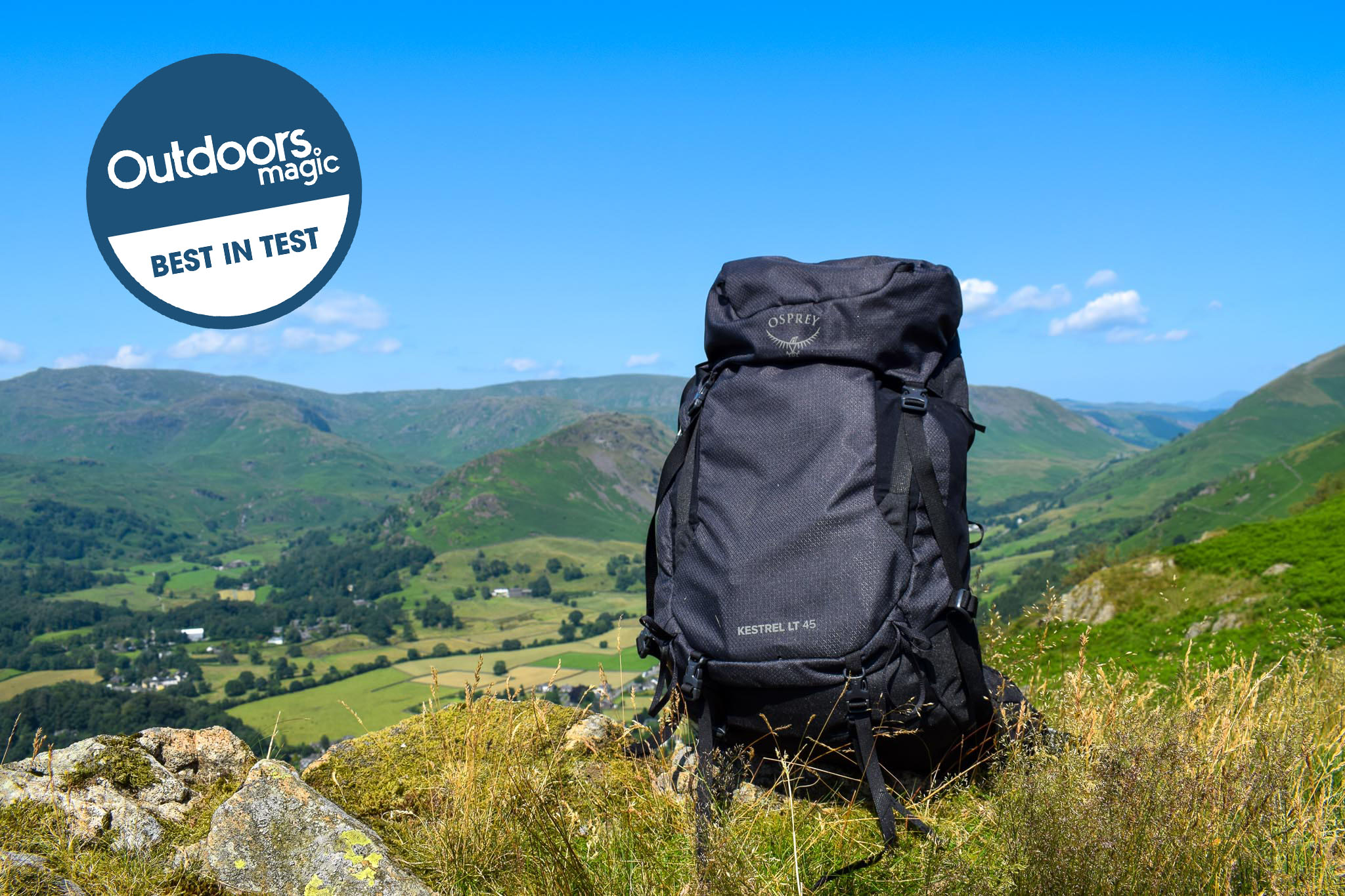
On test in the Lake District recently.
Both versions of the Kestrel/ Kyte still have Osprey’s iconic AirScape back panel, torso-length adjustability, built-in raincovers, side-zip access, and impressive internal organisation. What’s different now is that you have two great options instead of one to choose from, depending on what your hiking trip looks like.
Our tester James Forrest recently used the LT Kestrel along the Wordsworth Way. He said: “If you want a pack that is fully-featured and durable with a high-tech back system, the Kestrel is a sensible choice. It’s a gear-hauler that works well for overnighters.”
As we’ve come to expect from Osprey, there are loads of useful details, including ice axe/ trekking pole loops, a front shove-it pocket (we found this was perfect for a down jacket) and side access to the main compartment. Credit to Osprey for using bluesign approved 100% recycled fabrics here too.
Full Specifications
Made from bluesign approved, 100% recycled tough nylon / available in men’s (Kestrel) and women’s (Kyte) versions / various capacities within the range / rain cover at base / top-loading main compartment with cinch closure / internal hydration bladder sleeve / trekking pole and ice axe loops / stretchy and roomy side pockets / stretchy shove-it panel on front / padded hipbelt with pockets / side-zip secondary access / zippered pocket on top lid and under lid / 45L dimensions: 68H X 34W X 30D CM.
2. Ortlieb Atrack 35L Backpack
Selected as our choice for best waterproof backpack
Where To Buy
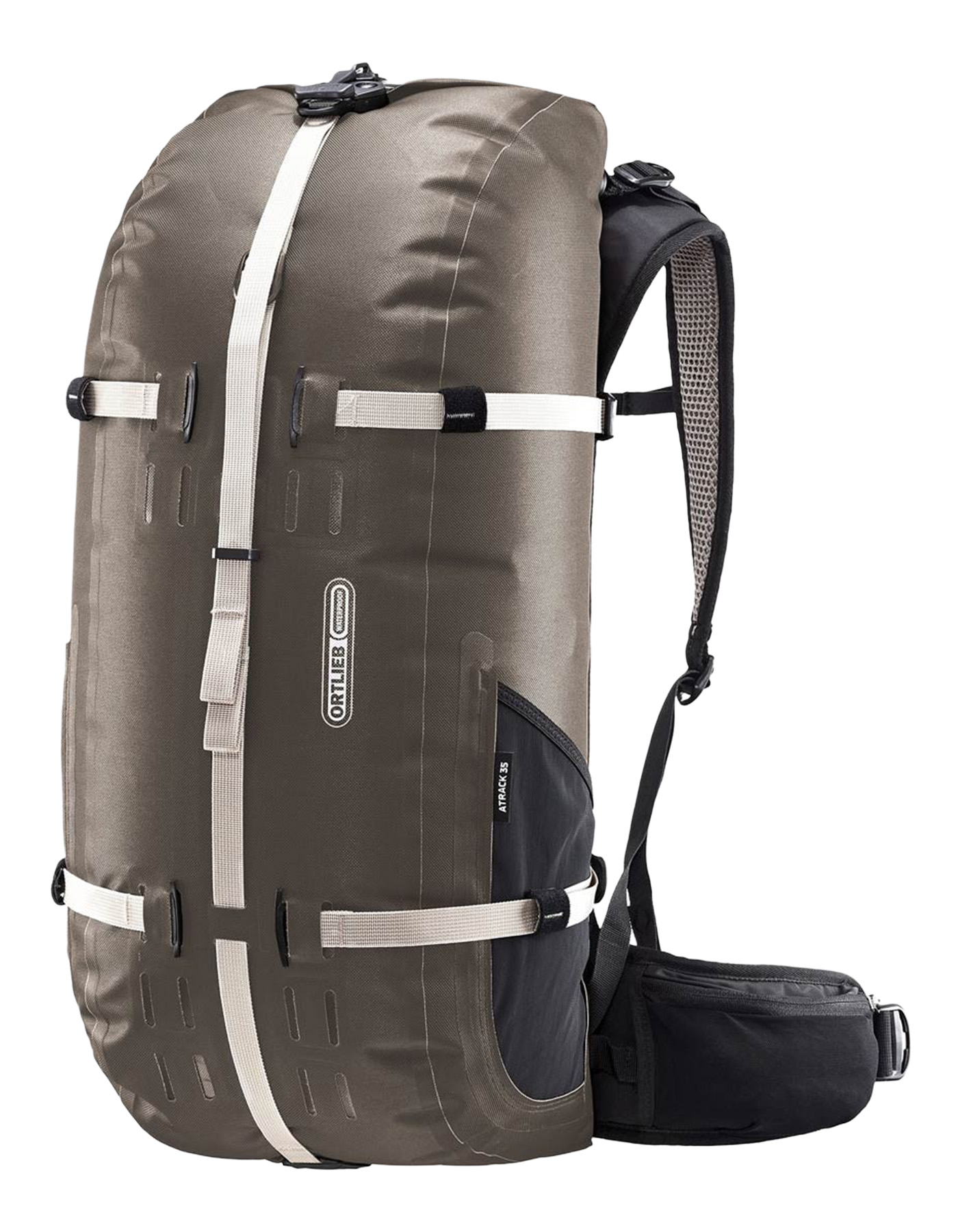
Ortlieb Atrack 35L
Our editor’s verdict: “This is a pack that trekkers, bikepackers, ski-tourers, kayakers and packrafters can all genuinely rally behind.”
Price: £220 Weight: 1560g Best for: Hiking in wet weather, canoe/kayak adventures Pros: fully waterproof, durable, very versatile Cons: doesn’t have all the extra organisation pockets of a non-waterproof bag
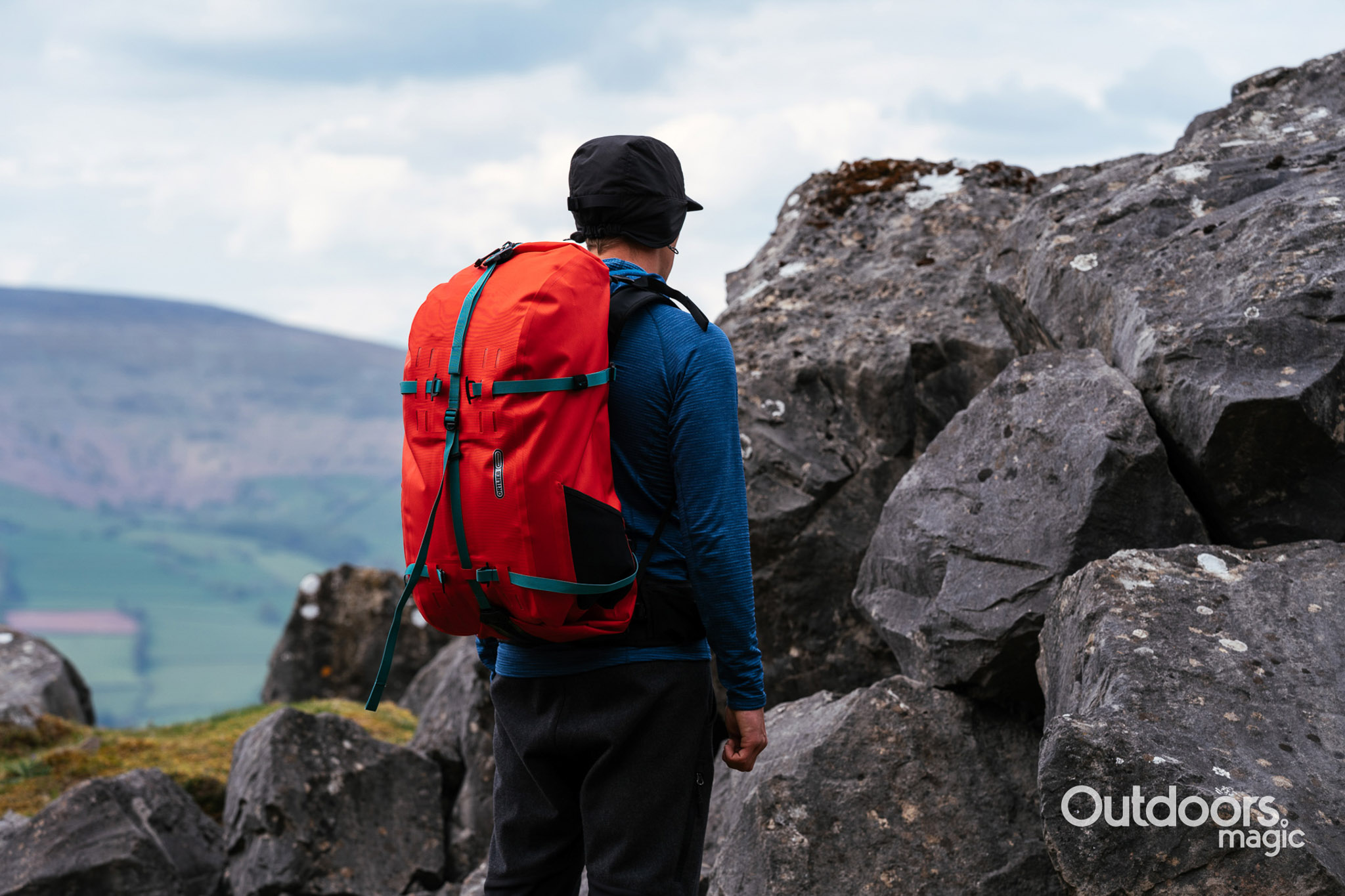
The Ortlieb Atrack 35L is a fully waterproof backpack ideally suited towards activities where you’re planning on taking a soaking, whether that be in rivers, lakes, oceans or just on hilltops. This is a pack that trekkers, bikepackers, ski-tourers, kayakers and packrafters can all genuinely rally behind.
A long waterproof zip is located on the back of the pack opens the bag up like a duffel bag, allowing you to get a look inside before picking out what’s needed. Internally, there are four zippered pockets on the Atrack while on the outside there are two net pockets perfectly suited for water bottle storage.
OM editor Will with the Atrack in Bannau Brycheiniog.
Our tester Ieuan Barrett said, “I’ve not tried it out with a massively heavy weight just yet but I’ve used it for a load of around 10kg containing my camera equipment, wet weather gear and lunch etc., and it coped well. The bag is very comfortable too, with the padding and structure at the back adding support whilst walking. The chest strap also aids in taking strain off the shoulders.”
During our tests, the durability of this thing really stood out – it feels extremely hardwearing. The carry comfort was good and the pack provided its promised wet weather performance. It’s a little fiddly in places and the main zip is quite stiff due to its waterproof design, but generally this is a pack that’s innovative and that comes across as being very well made and built for the outdoors.
Full Specifications
Tear resistant nylon fabric / 4 zippered inside pockets / adjustable back panel / ergonomic shoulder straps / two outside net pockets / daisy chains on the front / 4 compression belts
Our tester’s verdict: “I think this bag could be a game-changer for me. Gregory have fine tuned the balance between support and practicality very well here, honing in on adjustability wherever possible.”
Price: from £225 Weight: 1.59kg Best for: multi-day backpacking, long-distance outdoor adventures Pros: heaps of storage compartments, luxurious hipbelt, very comfy back system Cons: won’t suit ultralight hikers as much
Here at Outdoors Magic, we’ve been trying and testing Gregory packs for many years now. Previous models like the Alpinisto and Focal have impressed us, and this one hasn’t let us down either. While not geared towards ultralight hikers, in our experience, it feels light compared to other packs of this size on the market, and should suit most multi-day adventurers very well.
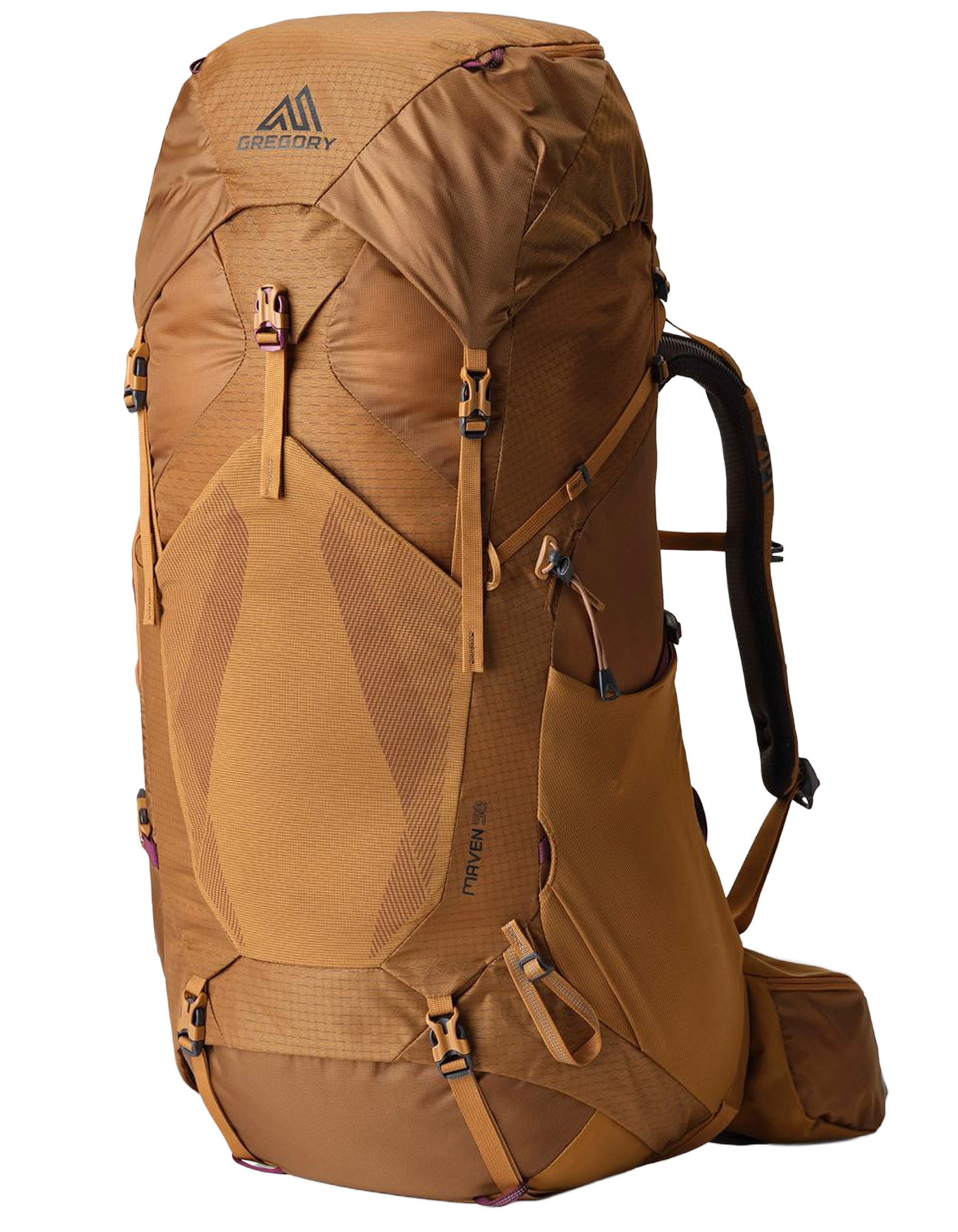
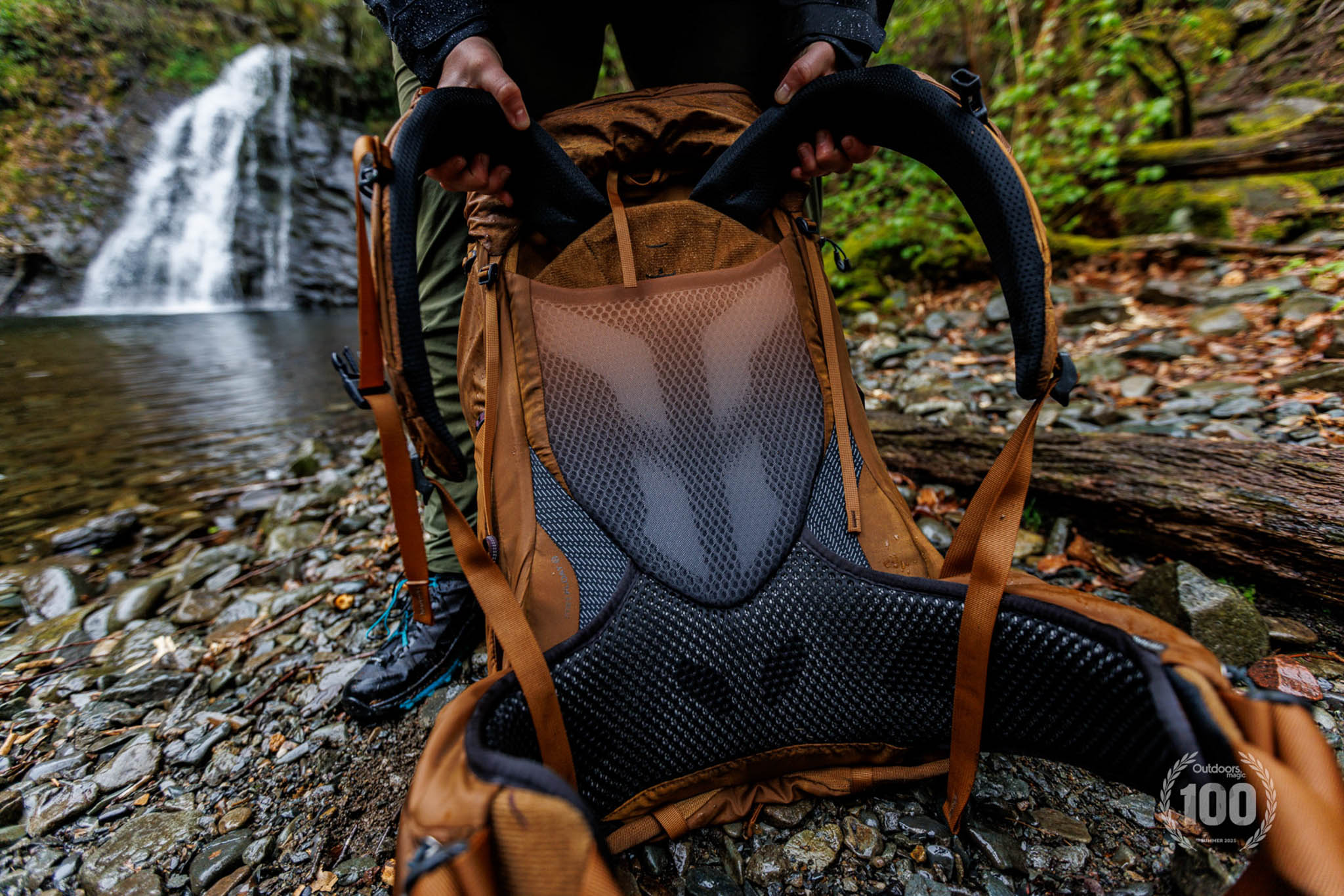
Our most recent gear tests have taken us to North Wales, in and around the Rhinogydd mountains to be precise, where we’ve been putting the Gregory Maven 58 through its paces. Specifically designed for women (the men’s equivalent is the Paragon), there’s a lot to like here, including an ergonomically designed hipbelt, an impressive AirCushion back panel, and heaps of innovative storage compartments for all your gear-hoarding needs.
OM tester Jazz out testing the Maven in North Wales. Photo: Dave MacFarlane.
“I’m roughly 5 foot 6 with a stocky and curvy build,” OM tester Jazz reports, “and I’ve been testing the S/M torso length. I’ve found that it’s super comfy, even on longer, heavily-packed hikes. As the body naturally changes shape throughout the day, I tend to adjust hiking bags quite a lot. The Maven has been great for this, with easy-to-use adjustment points all across the bag.”
“At 1.59kg with a 58L capacity and a supportive back frame, I’d personally consider this a lightweight backpacking bag, especially taking into account all of the features on offer. During my tests, I don’t think I’ve reached the maximum carry weight just yet (23kg), but I’ve never been a light packer and so far, it’s never felt uncomfortable and there’s been no excessive rubbing.”
Full Specifications
Available in a XS/S length / FreeFloat dynamic hipbelt / AirCushion mesh backpanel / perforated dual density shoulder harness / shoulder strap pocket designed for the Garmin inReach / perimeter alloy frame and fiberglass anti-barreling cross-stay / side-loading access zipper / internal hydration sleeve / floating top pocket with large zippered compartment and an underside zippered pocket / reflective attachment points and key clip / dual side stretch mesh pockets / front stretch mesh pocket with buckle closure / quick-pull drawcord closure and top webbing compression / zippered bottom sleeping bag compartment with removable divider / rain cover included under top lid / 70 x 35 x 27cm.
This is our pick as the best value backpack you can buy this year.
Where To Buy
Highlander Ben Nevis 52L
Our editor’s verdict: “All in all this is a pack that has all the right details for life on the trail and that seems built to last. It’s tough, it’s stacked with handy details, the back system is comfortable and ventilating and the price is very reasonable.”
Price: £125 Weight: 1.46kg Best for: multi-day backpacking, weekend wild camping Pros: good value, durable fabrics, good warranty, nice little details, smart look Cons: it would be good to see the use of recycled materials on future editions and the stretch mesh gets grubby quite easily
Following our tests, we think this is well worthy of our pick as the best value backpack you can buy this year.
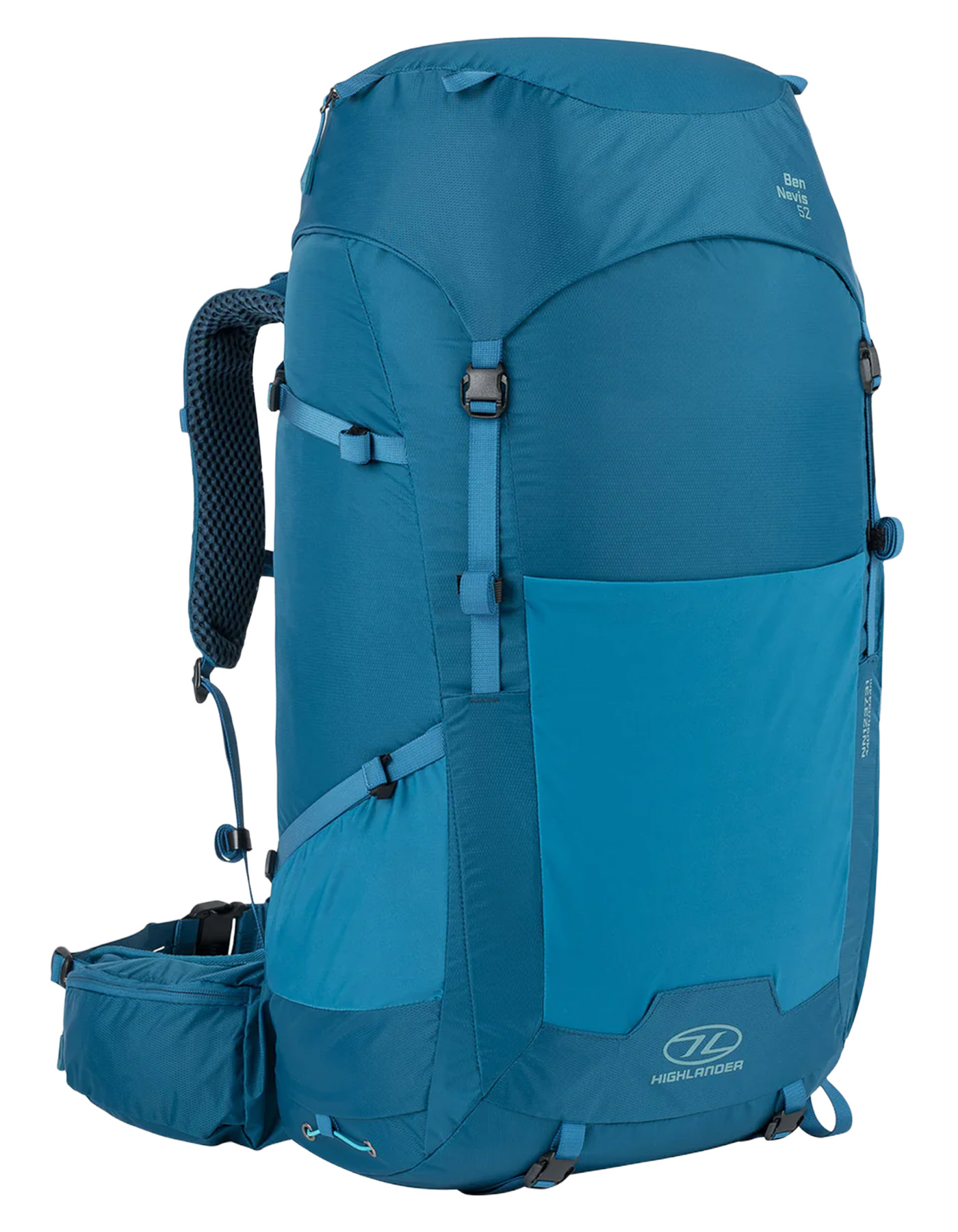
OK, £125 still isn’t cheap, but we think it’s pretty good value considering what you get from this. It’s a backpack that has a suspended back system that creates loads of airflow. There’s a sliding back panel too, so you can really refine the fit – and quickly and easily. It has large hipbelt pockets, stretchy mesh pockets and all the same details that other much more expensive packs have.
Will using the Highlander Ben Nevis on the Pembrokeshire Coast Path. Photo: Dave Macfarlane
The main material is a nylon with a 200D rating. We found this to be durable and able to withstand the usual levels of abrasion a heavily loaded backpack will tend to face. Fortunately, if there happens to be a defect that causes the pack to break, you’re covered by a 282 year guarantee. That’s a year for every Munro in Scotland.
Our tester said, “All in all this is a pack that has all the right details for life on the trail and that seems built to last. For me, 52 litres will handle kit for just about any trip I’ll undertake. That said, it might be a little on the small side for a Duke of Edinburgh student that’s loaded up like a typical Duke of Edinburgh student, if you catch my drift. It’s tough, it’s stacked with handy details, the back system is comfortable and ventilating and the price is very reasonable.”
Full Specifications
Available in men’s and women’s versions / also available in a 65L capacity / sliding back panel length adjustment / stretch mesh pockets / hydration bladder / side access / suspended back system.
Selected as the best ultralight backpack following our tests
Where to Buy
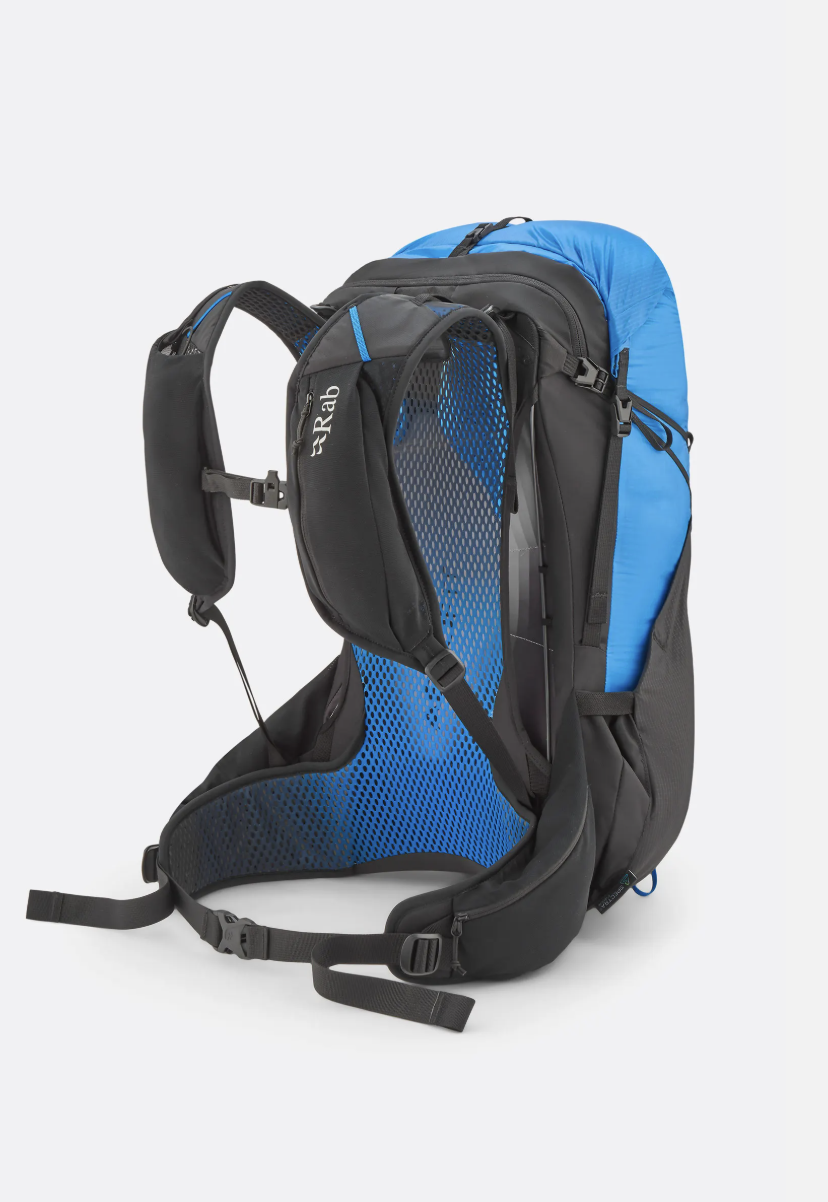
Rab Syclon XP 40
Our tester’s verdict: “Supremely light but with enough space for lightweight backpacking set ups. It also has high levels of ventilation while still providing a very stable carry.”
Price: £180 Weight: 890g Best for: three season lightweight backpacking and day hiking Pros: very light, stable and comfortable, waterproof, useful pockets, recycled materials Cons: some might find it too small for backpacking, only comes in one fixed back length, fabric not as durable as similar Dyneema alternatives
The carry comfort and stability that the Syclon XP offers are truly excellent. It’s a very comfortable pack that, despite its diminutive weight and construction, handles loads well. The waterproof material is a huge bonus to have and the assortment of pockets adds to its overall convenience.
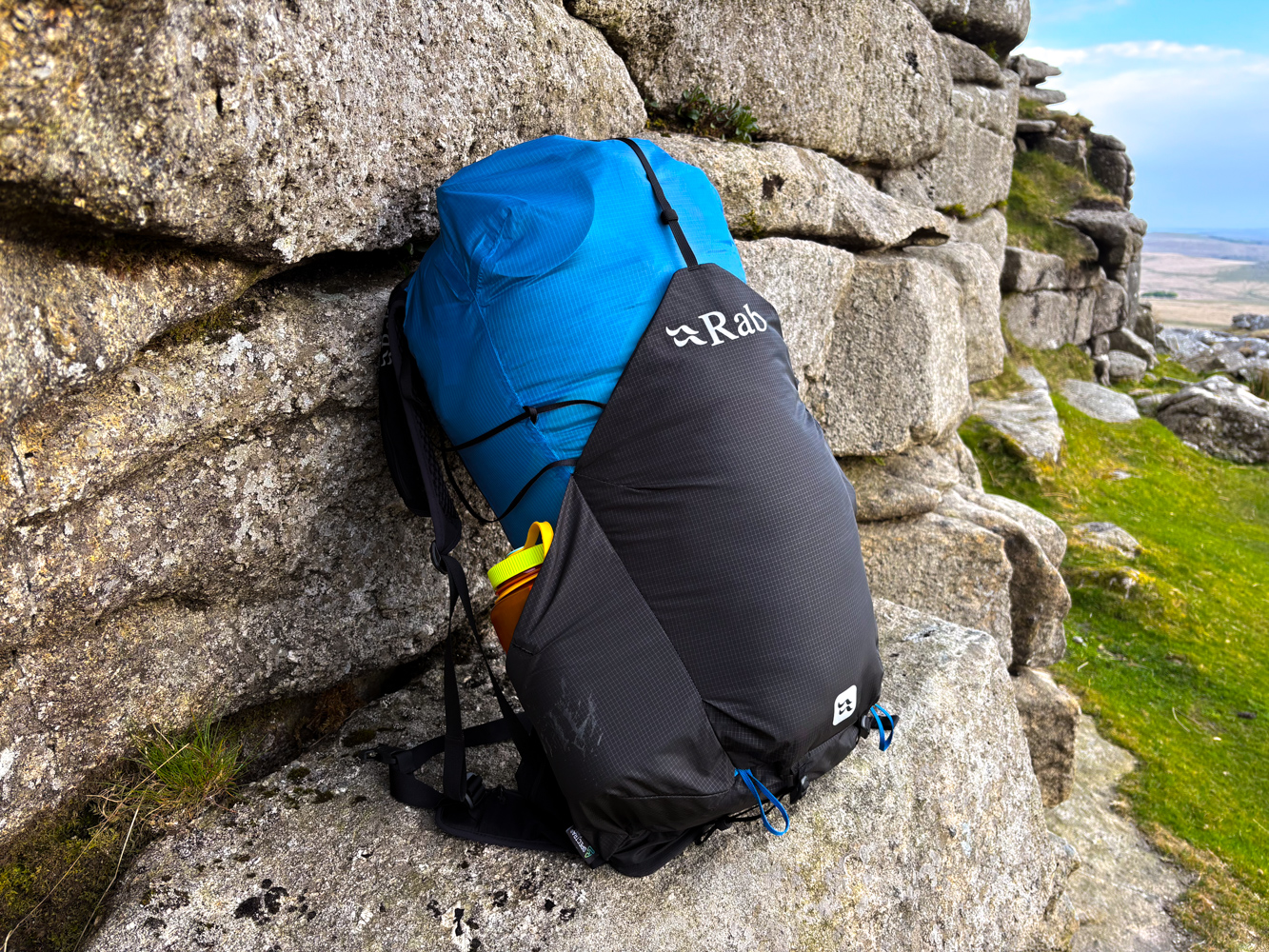
“For me”, OM editor Will reports, “its 40L volume makes it very well suited to thru-hiking, with enough space for all the essentials and room to spare for any extra meals (or a couple of small luxuries) you might want to carry.” We can see it being absolutely perfect for a multi-week thru-hike of the Pacific Crest Trail or the GR20. It would be particularly good for something like the Camino de Santiago, where the venting back system will come into its own in the hot Spanish weather.
The Rab Syclon XP 40 during OM editor Will’s tests.
“Walking with it, I haven’t found it restrictive at all,” Will continues. Instead, it seems to move naturally with your body and stride, rather than against it. There’s very little sway or bouncing, even when moving quickly over rough ground, and the vest-style harness helps the pack feel almost anchored to your torso. On uneven terrain especially, it moves with the natural rotation and rhythm of your gait rather than feeling like a separate weight shifting around behind you. It’s an aspect of the pack that has hugely impressed me.”
The Rab Syclon XP weighs 800g in total, putting it firmly in the ultralight category. For context, the Osprey Kestrel 38 weighs 1.84kg. Its main material is a 40D high-tenacity nylon which is derived entirely from recycled materials. This has a roll-top and fully taped seams, all combining to create a main compartment that has an IPX4 waterproof rating. There’s one large dump pocket across the front, a zipped pocket at the top and then side stash pockets too.
Full Specifications
Main fabric: 100% recycled 40D high tenacity nylon / secondary fabric: 85% recycled 100D high tenacity nylon with Spectra ripstop / fabric lining: 210D nylon / dimensions: 63 x 34 x 28cm / IPX4 rated waterproofing / Aerofit carry system / roll top entry / front stash pocket, chest strap storage, hipbelt pockets, and side water bottle pockets / walking pole attachment points / side and base compression points / 28, 30, 38 and 40L capacities available.
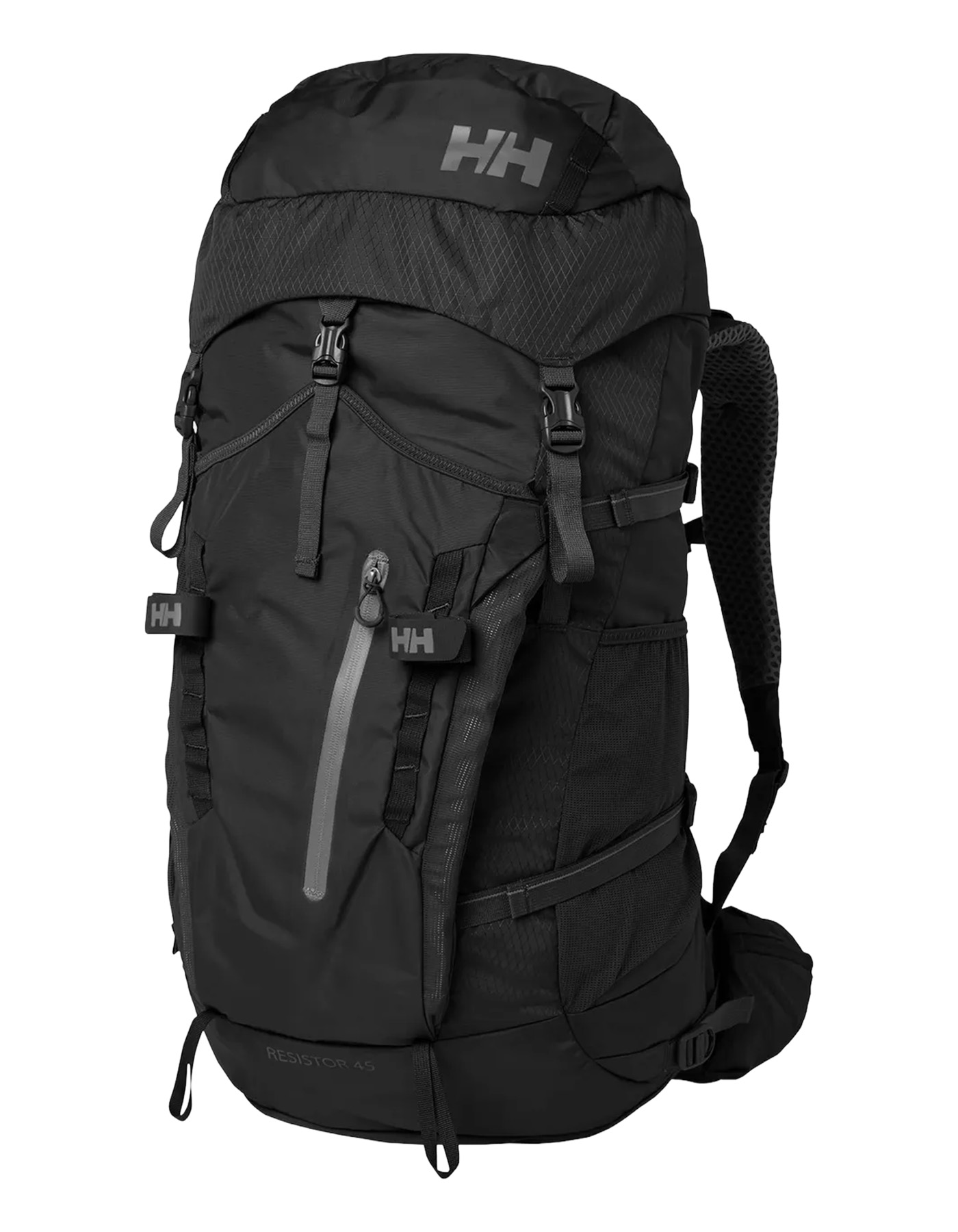
Price: £200 Weight: approx. 1.5kg Best for: mountain hiking, multi-day trips, hiking that requires heavy loads Pros: lots of mountain ready features, comfortable hipbelt and back system (the thick padding is a highlight), RECCO capabilities, robust design Cons: on the heavy side, can’t adjust back length, unsure of recycled content
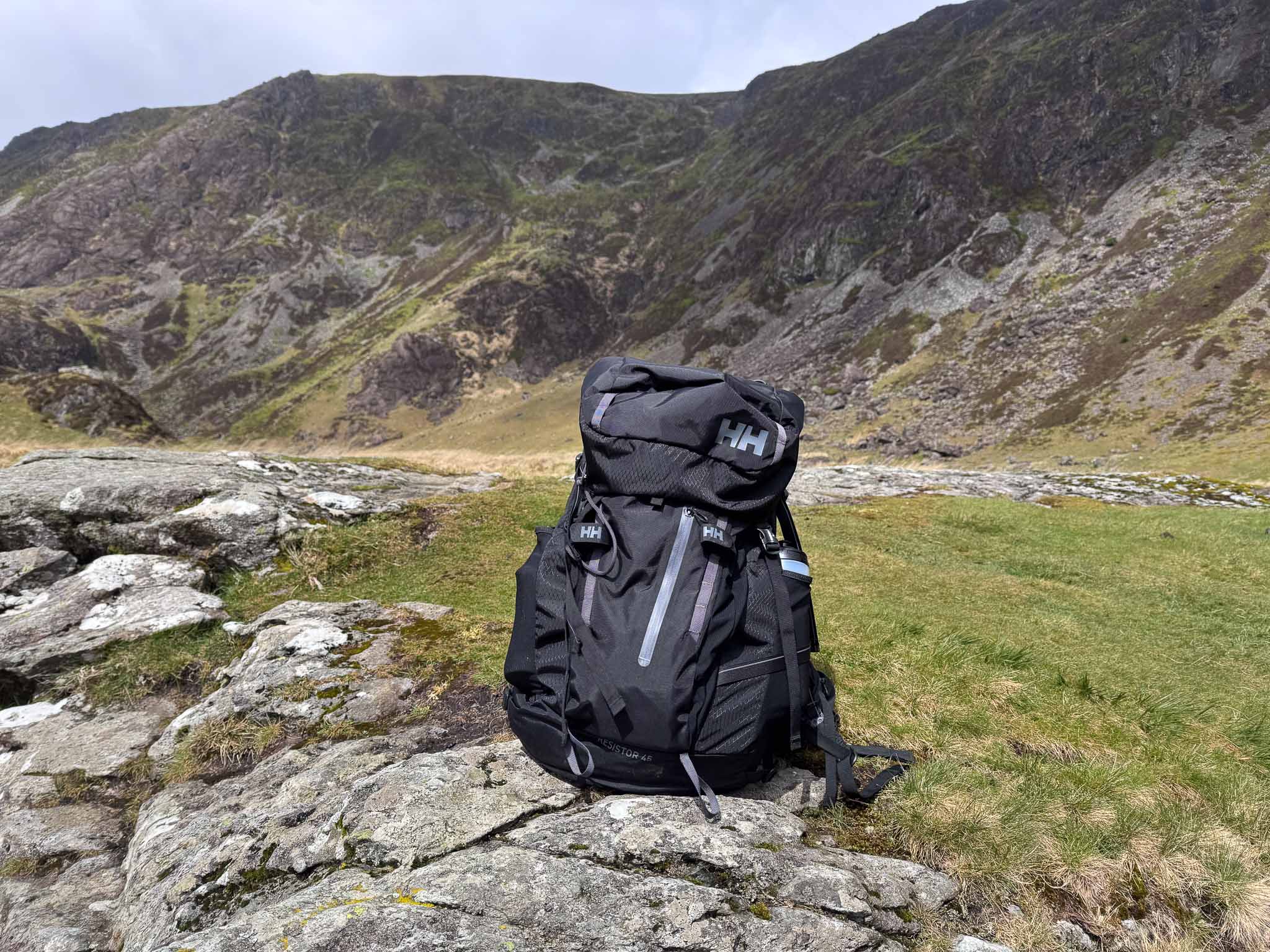
We’ve been testing Helly Hansen’s Resistor backpack this spring and so far, we’ve liked what we’ve seen. During our hiking tests, most recently in the Meirionnydd range of southern Eryri (Snowdonia National Park), it’s proved itself to be a mountain-ready, well-featured pack that handles heavy loads well.
Out and about in southern Eryri.
While not the most lightweight multi-day hiking backpack out there, it feels more built for durability in this respect. The design feels robust and the materials have a hard-wearing quality to them. OM tester Jazz said, “I tend to sling my pack down just about anywhere, and so far, the Resistor has handled light abrasion well. Yes this might make the pack a little heavier, but I personally value long-term durability before anything else.”
She continues, “If you’re after the ultralight experience, I’d look elsewhere. But if you’re looking for a hardy pack that’s got all the features you’ll need for big days in the mountains, I think you’ll get along well with the Resistor. I’m yet to use the pack in the full throws of summer but so far, I’ve found the back system very comfortable to wear on long mileage days, and fairly breathable (not overly hot but not ultra breathable either – somewhere in the middle) overall. The hipbelt in particular feels plush around your waist, even with heavy loads.”
The water resistance held up well against some light rain on top of Cadair Idris.
£200 isn’t the cheapest price on this list, but it’s by far the most expensive. And for what you can get out of this pack in terms of the feature set and durability, we think it’s a good value option to consider. The 45L hits a sweet spot for multi-day hiking too, where you want just enough room for all of your essentials, but nothing too large that’ll tire you out half way through a thru-hiking route.
It’s worth mentioning that the model is unisex with only one size available. The back length isn’t adjustable either so we’d advise trying before you buy.
Full Specifications
Integrated RECCO transponder on top of lid / 3D internal wire frame / perforated EVA foam back panel / two hipbelt pockets / glove-friendly YKK zippers / adjustable harness / top-loading main compartment / expandable spindrift collar / expandable stuff pocket at front / lid security pocket with key clip / hydration compatibility / side pockets with compression straps / whistle in sternum strap.
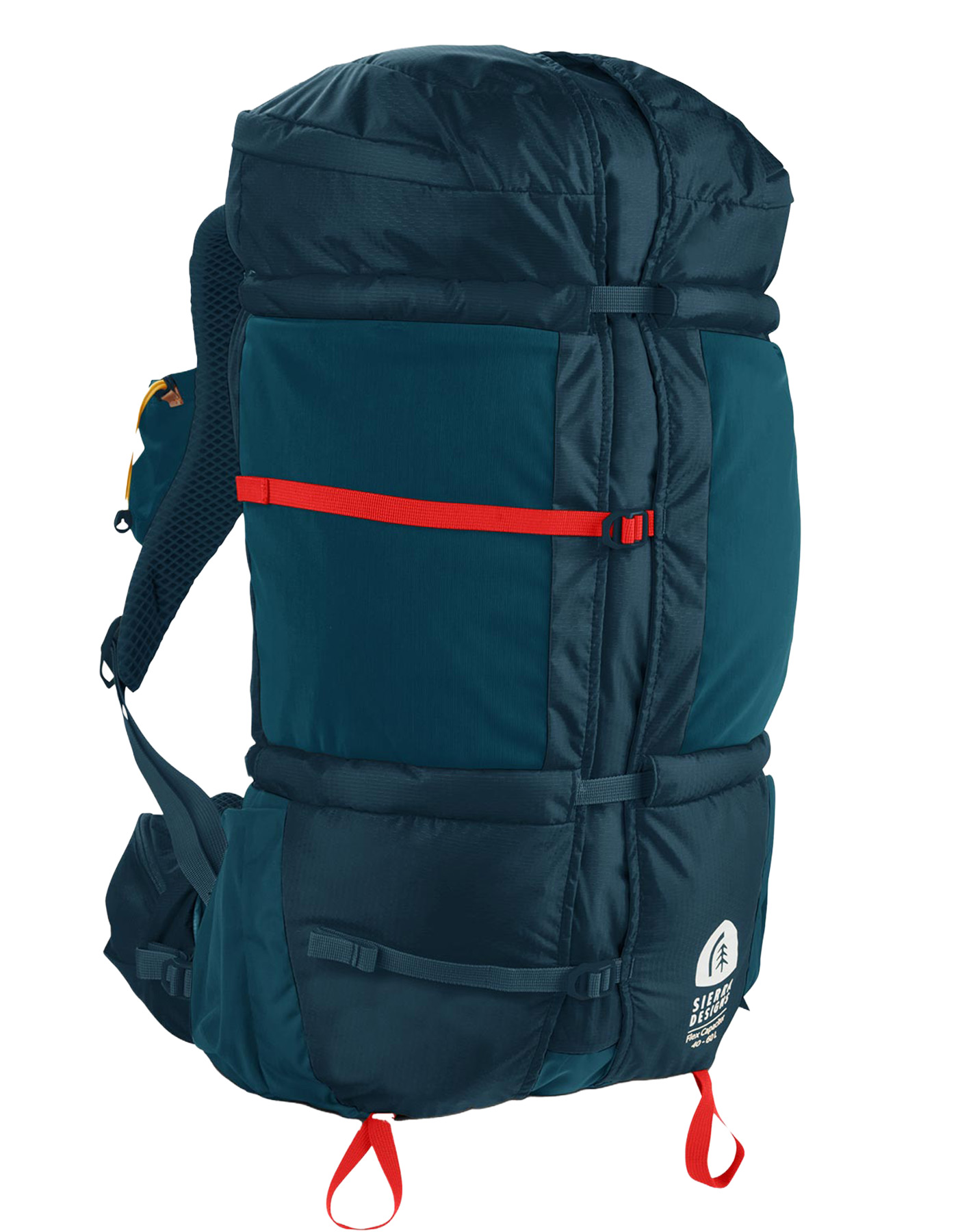
7. Sierra Designs Flex Capacitor 40-60L Backpack
Where To Buy
Sierra Designs Flex Capacitor 40-60L
Our editor’s verdict: “I found it really comfortable to wear, even when it was heavily loaded, and I loved all of the handy details, including the stretchy pockets on the sides and across the harness.”
Price: £190 Weight: 1.23kg Best for: Backpacking and wild camping Pros: useful expanding volume, lightweight, good carry comfort, lots of pockets Cons: not waterproof and doesn’t come with a waterproof cover
The Flex Capacitor is a lightweight backpacking rucksack with a genuine USP: a clever expanding gusset that allows the pack to expand in volume by up to 20 litres, simply with the tweaking of a few straps. You see, while most backpacks use top-loading designs, this one expands outwards, providing useful additional capacity in its main compartment without affecting load-carrying stability or comfort.
For any backpacker who’s ever needed to overstuff a pack in order to take on extra food, water or other supplies, this thing is a genuine game changer.
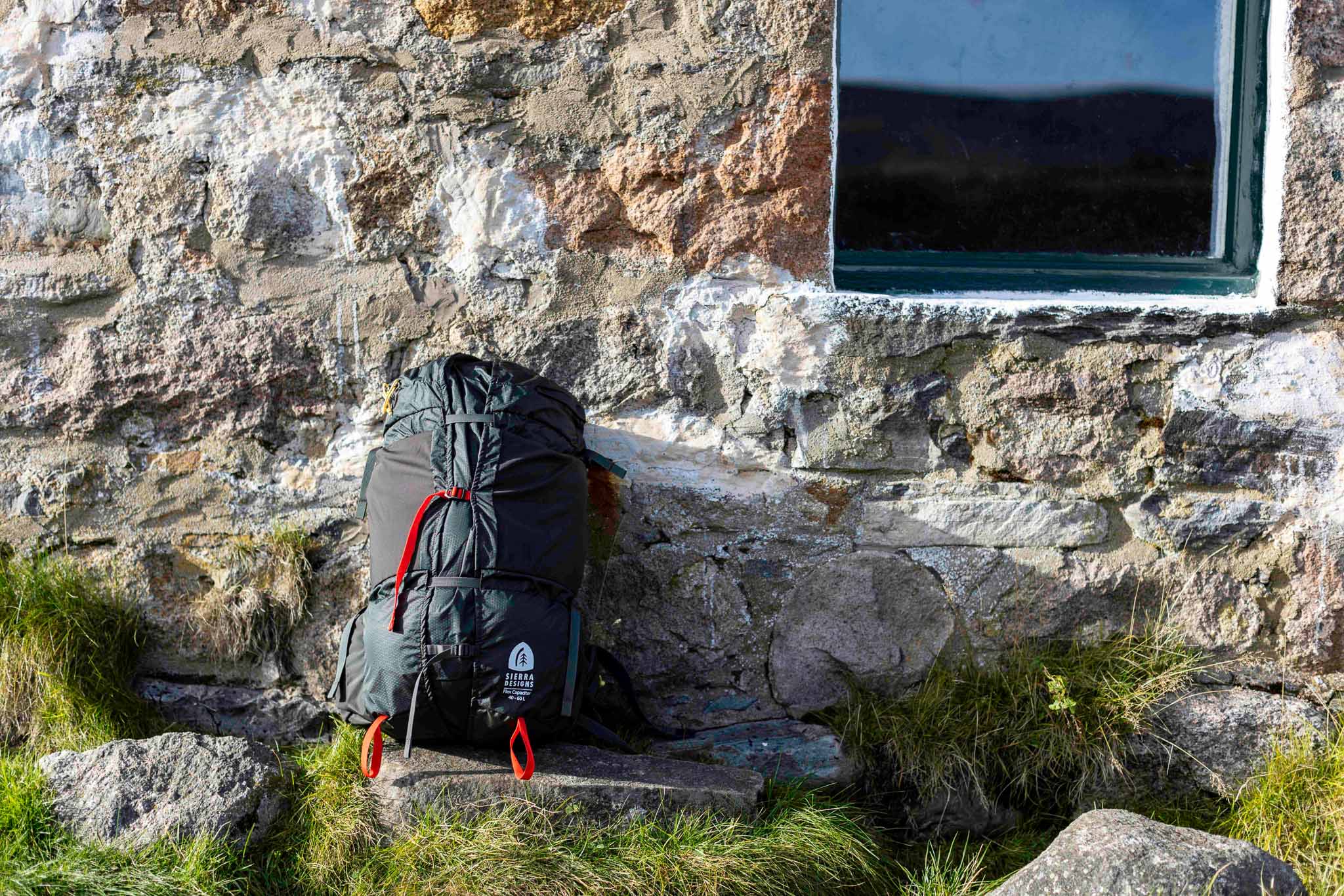
The Sierra Designs Flex Capacitor in use during our trip to Ryvoan Bothy. Photo: Dave Macfarlane
During our tests, we discovered that the Flex Capacitor does a lot of other things well too. Our tester said, “I found it really comfortable to wear, even when it was heavily loaded, and I loved all of the handy details, including the stretchy pockets on the sides and across the harness. These give the bag loads of extra space for snacks, maps, GPS devices and also extra layers. The durability was noteworthy too.”
This thing’s made from a 100D nylon honeycomb fabric combined with an even tougher 420D fabric at the base, making it well capable of shrugging off sharp branches and any rough rock. There isn’t a base zip or side zip to help you access things buried in the pack, but the opening at the top is nice and wide, so you can see right into it and pull out your kit easily.
We found that the main downside to this pack is that it isn’t waterproof and doesn’t come with a waterproof cover, so you’ll need to carry everything in dry bags if you’re heading out into conditions that could be wet.
Full Specifications
Capacity: 40-60L / available in two sizes: S/M and M/L / hydration sleeve doubles as a removable small bag / 2 stretch mesh side pockets / zipped pockets on hipbelt / trekking pole loops / 100D and 420D fabrics.
Our tester’s verdict: “I like how tough this backpack is. While there’s not much in the way of recycled content, the material itself feels robust and has held up well on the trail. The back panel is pretty breathable too and uses a suspended mesh fabric with a reinforced frame.”
Price: £89.99 Weight: 1600g Best for: hikers looking for a good value option, long distance and multi-day walking Pros: outer fabric feels tough and abrasion resistant, there’s lots of adjustment options, internal organisation is handy Cons: a little squeaky at times, sits quite high on larger bodies
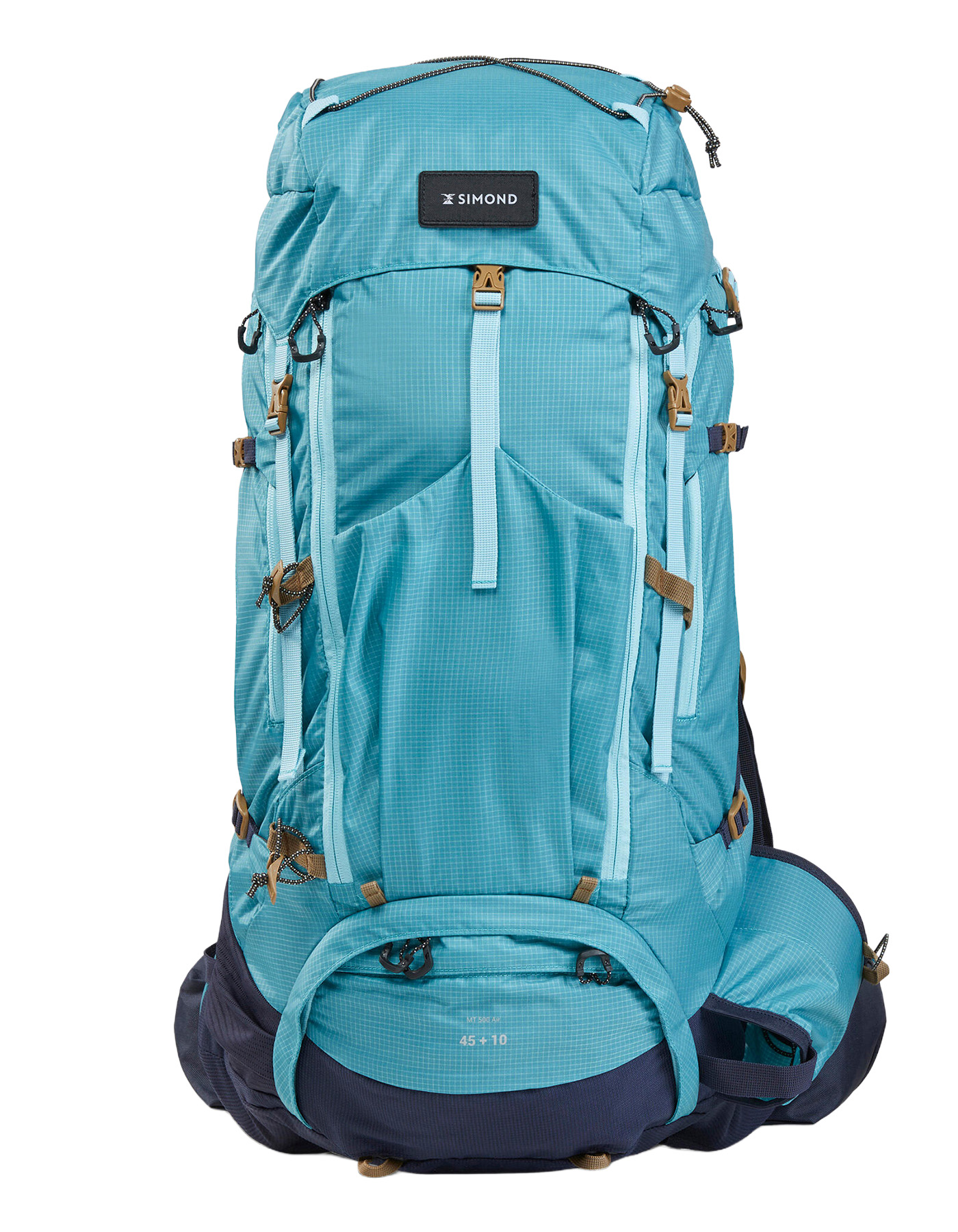
The Decathlon MT500 45+10L trekking backpack delivers impressive versatility and storage without the premium price tag usually attached to packs of this size. Its expandable design, generous front opening, and separate bottom access make packing and organising gear particularly straightforward.
Our tester Jazz has been trying out the women’s model. She commented, “What stands out most to me is how tough the fabric feels. Although it doesn’t use a huge amount of recycled material, the fabric feels hard-wearing and has coped really well with regular trail use. The suspended mesh back panel also provides decent airflow and is supported by a sturdy frame. That construction does add some extra weight, but for me it’s a worthwhile compromise for the added support.”
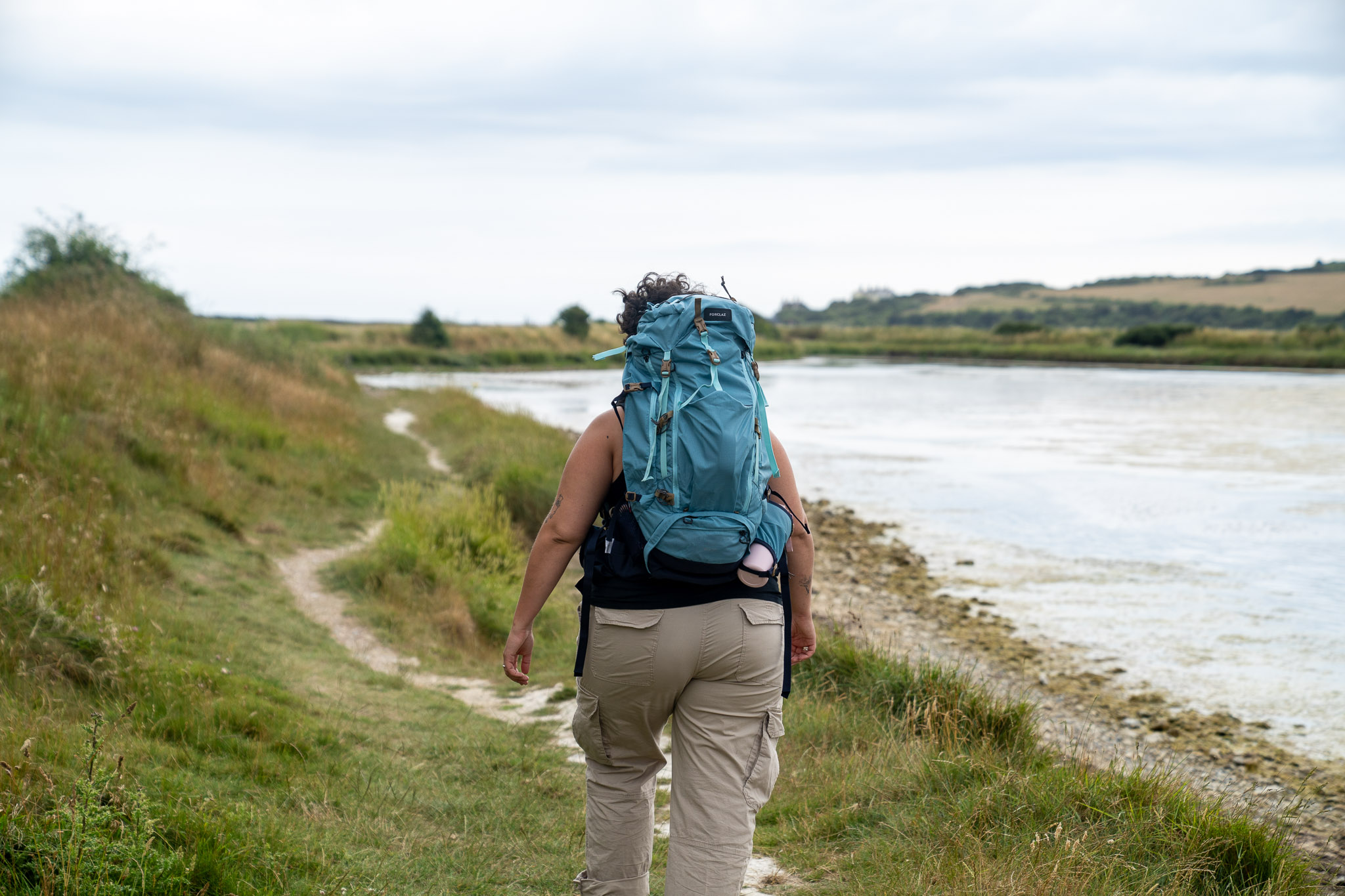
One of our gear testers Cinthia out on the South Downs Way with the Simond Trekking MT500 backpack.
She added, “There are eight pockets overall, along with plenty of adjustment options. One of my favourite features is the clever bottle holder, although it works best when tightened securely. The adjustable back system gives the pack a flexible fit, though I found the mechanism slightly awkward to adjust at times.”
Overall, the MT500 offers strong value for money considering the features and capacity on offer. That said, if comfort and a smoother carry system are your top priorities, it may be worth investing a little extra on a more premium option.
Full Specifications
45-litre capacity with a 10-litre extension top flap / designed specifically for the female anatomy, featuring adjusted shoulder straps and conical waist belt shape / 2026 version features upgraded ventilated back structure with suspended mesh panel / reinforced frame for rigidity / 8 pockets in total / 210D Polyamide ripstop main fabric / reinforced base / 10-year warranty / rain cover included / pole holder, water bottle holders, internal bladder compartment / multi-use external straps.
9. Osprey Talon 55L Backpack
Where To Buy
Osprey Talon 55L
Our editor’s verdict: “It’s comfortable, convenient, it feels aerodynamic and it also feels well made and durable too – it’s the kind of pack that gives the impression that it’ll last a long time.”
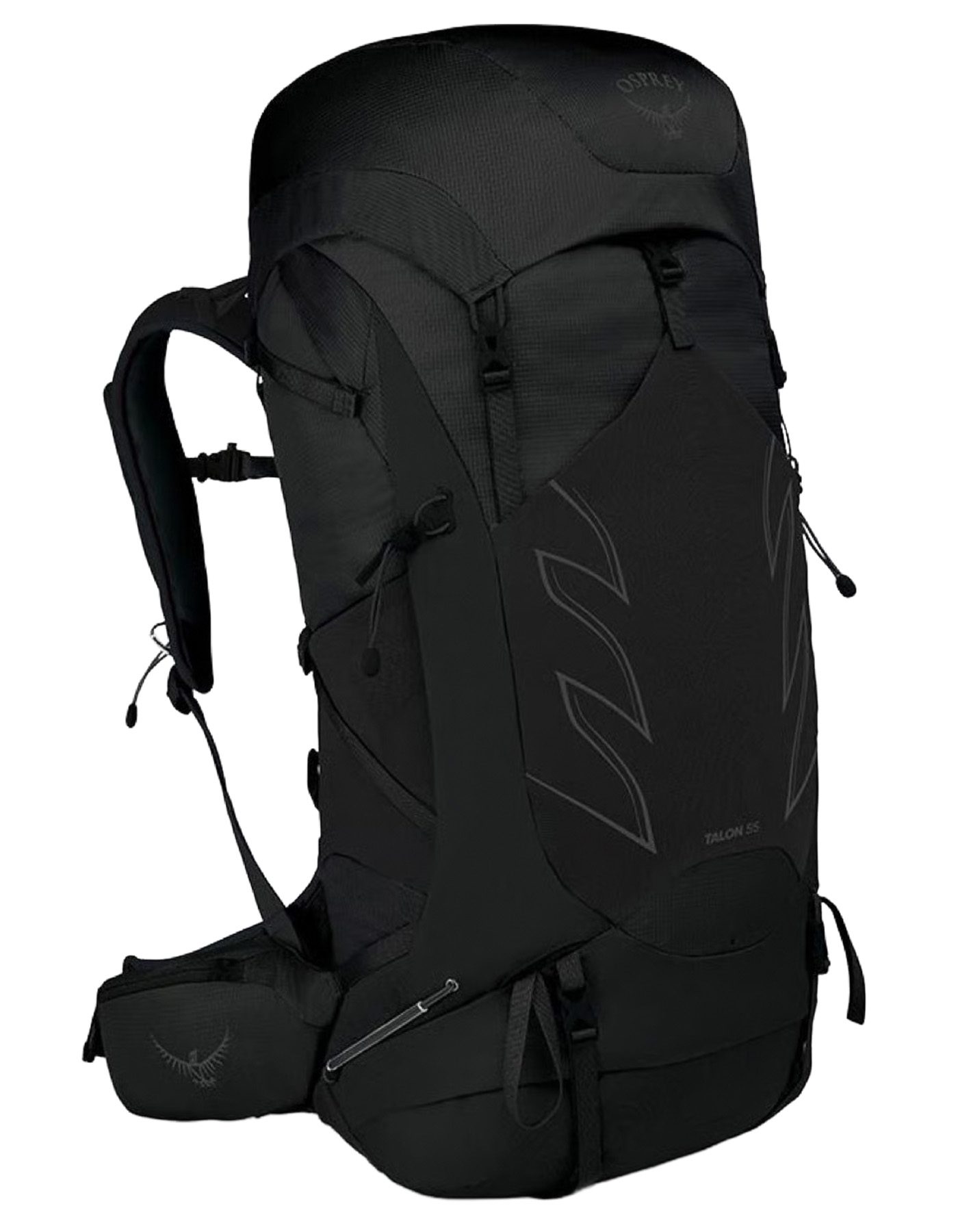
Price: £162 Weight: 1442g Best for: backpacking, travel Pros: packs flat, excellent load bearing and balance, recycled fabrics Cons: not as much airflow as a suspended mesh back system
What we like most about this pack is its body-hugging fit. It stays very close to your back, keeping the weight of your load centred to make you feel very stable. Fortunately, we found that there’s no trade-off with ventilation either as we found this to be breathable and comfortable with no noticeable problems with sweat build up.
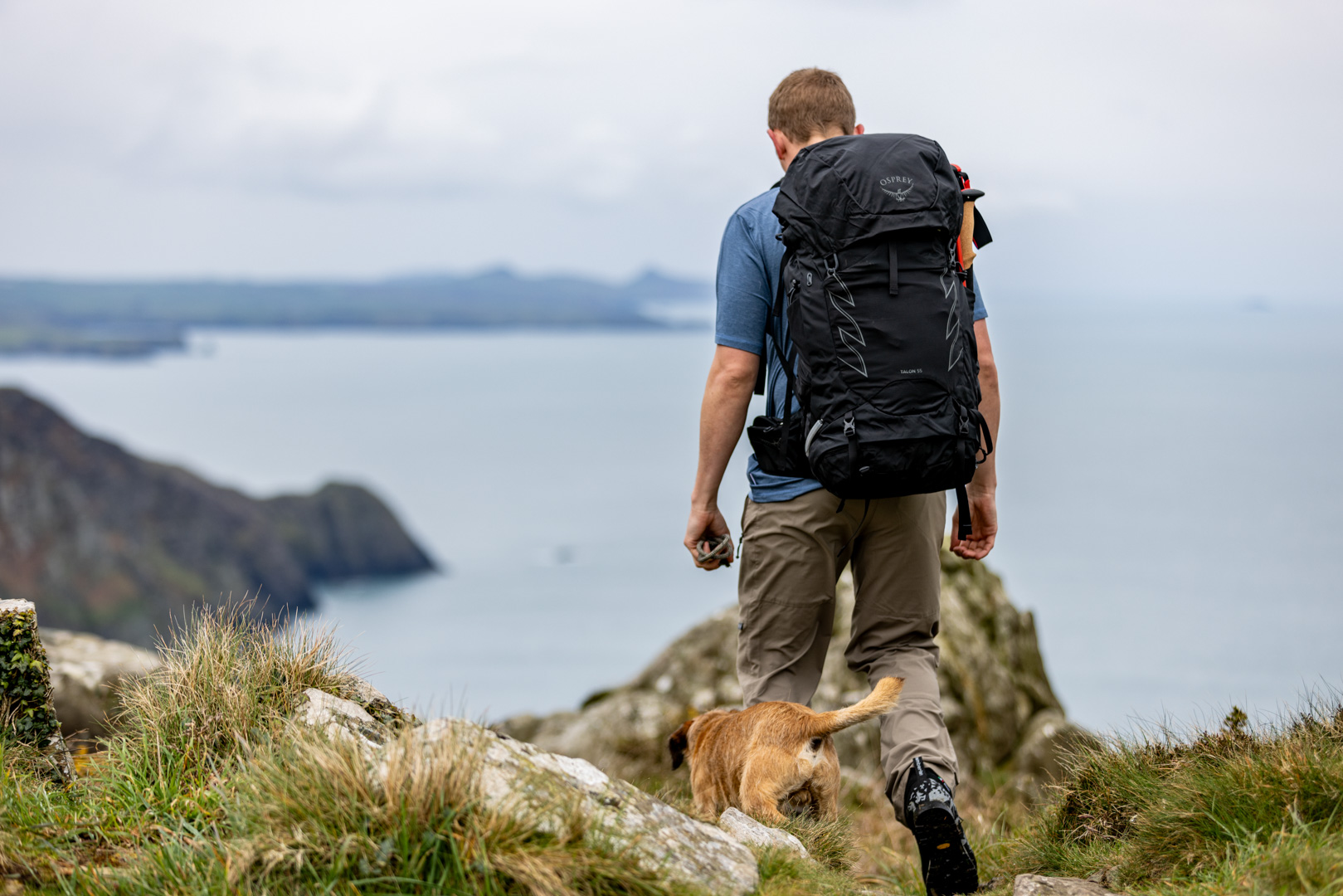
Will and his dog Griff using the Osprey Talon 55 on a multi-day trip.
There are packs of all shapes and sizes in the Talon and Tempest range from Osprey. This, the Talon 55L, is the best for multi-day hikes (the nearest women’s equivalent would be the Tempest 50L). It’s not the lightest of packs but it’s not heavy either, which is actually quite surprising given the durability of the fabric and also all the nifty features and details. The Talon 55L has three-points of access to the main compartment, big stretchy mesh pockets which can swallow a heck of a lot, trekking pole attachment points and a bladder sleeve. The only thing we think it’s lacking is a waterproof cover. Apart from that it’s a very useful, functional and comfortable pack that feels built to last.
Our tester said, “It’s comfortable, convenient, it feels aerodynamic and it also feels well made and durable too – it’s the kind of pack that gives the impression that it’ll last a long time.” If you’re wondering how the Talon differs from the Osprey Kestrel, which we’ve also included here, it’s a bit lighter and also versatile enough for fastpacking and even cycling. The Kestrel, on the other hand, is very much hiking-specific.
Full Specifications
Available in a women’s version called the Tempest 50 / bluesign approved recycled fabrics / top, side and bottom entry / foam back panel / packs down flat / sliding back panel / available in S/M and L/XL sizes.
Our tester’s verdict: ““The design and build of the bag is really effective, and to say it’s tough is an under statement. The materials used in every aspect of the bag right down to the zips and padding are just stunning.”
Price: £285 Weight: 2260g Best for: wild camping, backpacking Pros: durable, eco-friendly, built-to-last, timeless Cons: heaviest on the list
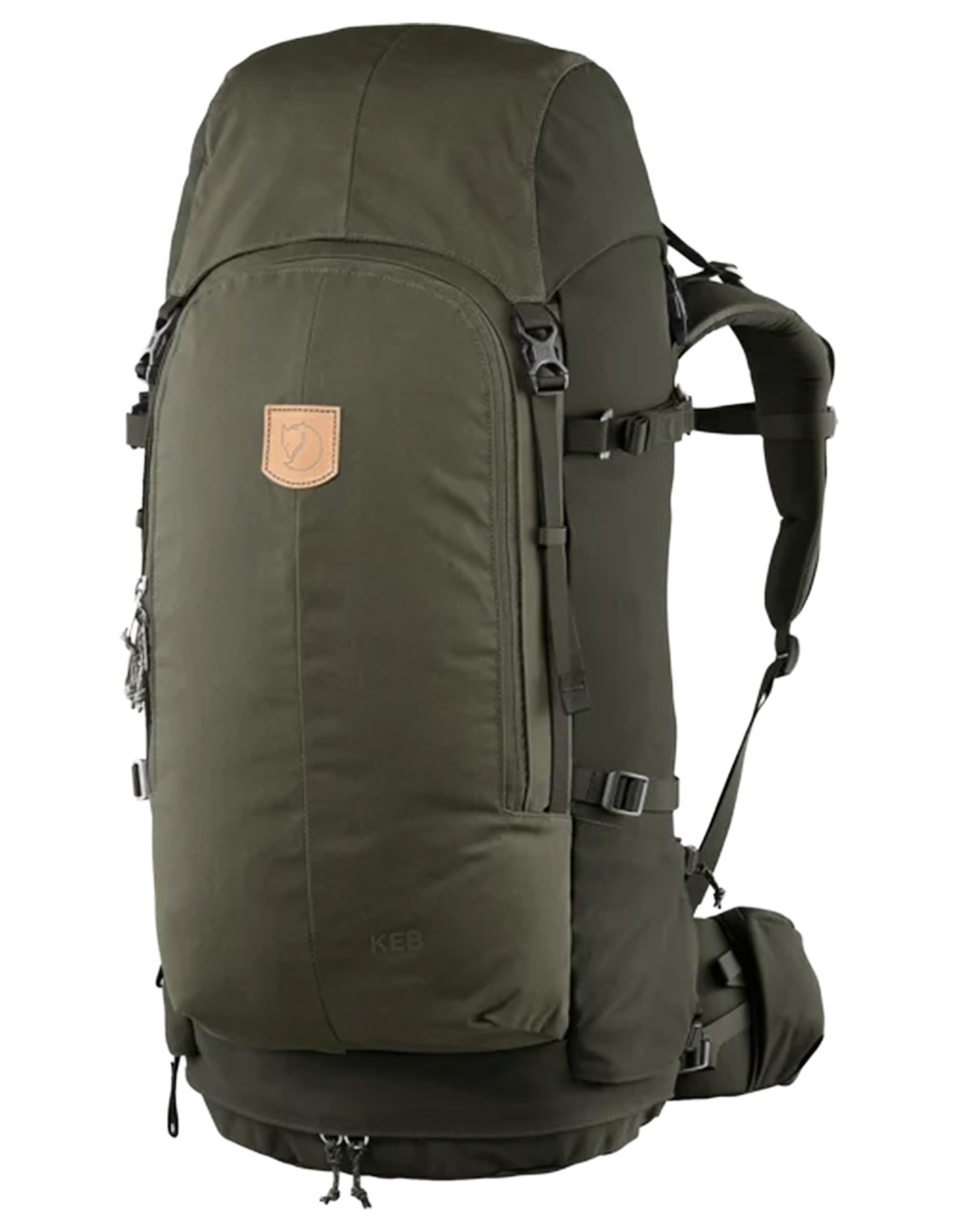
If you’re one of those people who appreciates careful design and timeless styling then you’re going to really like this pack. It’s a real thing of beauty. It’s only real downside is the fact that its traditional materials put it a little on the heavy side compared to packs with modern fabrics and frames.
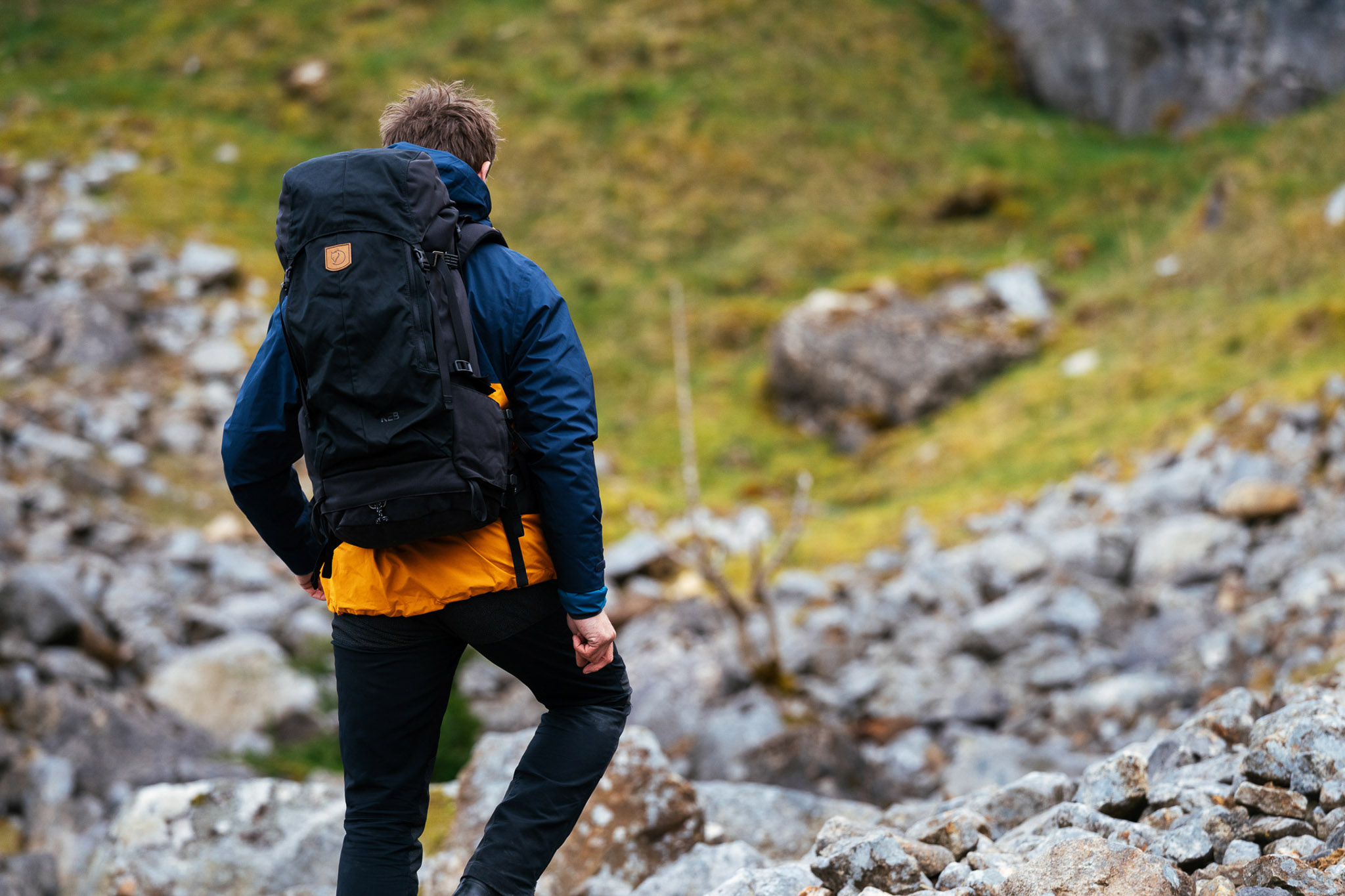
As we found out during our tests in Wales, this thing is built for outdoor performance – it’s made by designed used to the Swedish wilderness after all. The eco-friendly G1000 waxed polycotton fabric provided excellent water resistance and gave a sense of long term durability, you’ve then got the Bergshell fabric which is made from recycled nylon to further boost the Keb’s eco credentials and there’s the wooden frame which, according to Fjällräven, reduces CO2 emissions during the bag’s production by 90%.
Photo: Chris Johnson
This unique wooden frame is easily adjusted to suit a variety of back lengths and its complimented by padding and a touch of ventilation lining the back panel.
There are open side pockets for a water bottle or other small items you need access to quickly, two fairly sizeable zipped pockets on the hipbelt which provide a decent amount of weather protection, one big U-shaped pocket on the front, and then a zipped overlid pocket and small underlid one that stores the detachable rain cover.
Full Specifications
Durable G-1000 HeavyDuty Eco S / recycled polyester and organic cotton / base and sides in waterproof Bergshell fabric made from recycled nylon / unique wooden frame reduces CO2 emissions by 90% / attachment points for skis and ice axes/poles.
The first thing to consider when choosing a pack, as we mentioned in the intro to this article, is the volume. Does it match up to the load you’ll be carrying? If you’re going into the wilderness for a long period then you’re going to want a pack that can manage the amount of supplies you’ll need – something usually that’s over 50 litres. For hiking something like a national trail, I tend to look for a backpack that’s around the 40-litre mark, while if it’s summer and I want to take a lightweight approach I might carry something smaller, perhaps at around the 35-litre mark. You do see quite a few packs these days that are designed to handle varied loads, giving you adjustment straps and gussets to help the pack expand or shrink to your preference. These can be really handy and essentially give you two (or more!) packs wrapped up in one. The Sierra Designs Flex Capacitor pack is a very good example of this. As is the Fjallraven Keb.
Fit
Backpacks often come in different sizes as well as different volume. The size can usually be found on a little tag at the bottom of the back panel and brands normally state the back length in their product descriptions and usually guide to understanding their sizings. If you’re buying a pack online, most good brands will provide guidance on back lengths and corresponding sizes.
If you’re trying a backpack on in a store, once you’ve picked out the right volume and back size, make sure all the straps are done up – the hipbelt of course, and also the sternum strap across the chest – they all make a surprising difference to fit and weight distribution. Make sure there are no bits that poke you or have the potential to be sore, and that you feel your movement isn’t impeded when you walk. I personally think that a pack should sit on my hips with the straps on the shoulders taking some weight but certainly not the bulk of it. The back panel should be totally flush with my back and, with the pack on, I should be able to stand with a straight posture without difficulty, even with a full load.
Back System and Harness
Some packs have complicated adjustable back systems designed to make heavy loads more manageable and to allow for airflow too. These packs, more often than not, can be on the heavier side. Other packs can have very simple back systems, with minimal padding and ventilation. These tend to be found on some of the lighter, more minimalist packs on the market.
Out testing the Osprey Kestrel.
Choosing the right kind of back system for you depends on your needs. If I’m going minimalist and care about the weight of the kit I’m carrying then I’ll favour a simple back system. Conversely, if I’m not too bothered about weight and would prefer the heavy load I’m carrying to feel comfortable then in that instance I’d opt for a backpack with a suspended and well-padded back system. You can read more on this subject in our ventilated packs buyer’s guide.
Pack Access
Access is perhaps the next most important thing to think about. Larger packs (45-55L) benefit from an access point at the side or bottom, rather than just the top. The lid too needs to be easy to access and open.
Pockets are increasingly scarce on pack models these days – I’m not a fan of superfluous features – but one or two of them are useful to keep wet clothes or food separate and the like.
Rain Protection
Backpacks are rarely waterproof (though there are exceptions, the Ortlieb Atrack being a good example there). Many will have some kind of water-resistant treatment and the fabric will stand up to a fair amount of moisture. Several will also come with rain covers or you can buy covers separately to use with them. These are of limited use in very bad wind and rain. In those types of conditions, it’s much better to pack your items in dry bags within the pack first.
For more info on the above, check out our in-depth buyer’s guide to backpacking backpacks which was composed by record-breaking long-distance trekker James Forrest.